Merab Abramishvili (1957, March 16, Tbilisi – 2006, July 22, Tbilisi) was a Georgian artist and a member of “The Generation of the 80s,” a modern interpreter of medieval Georgian wall and icon painting techniques. In the post-Soviet period, together with several artists, he revived the traditions of Georgian religious painting and established a contemporary model.
The artist was born in Tbilisi to Guram Abramishvili, an art historian, head of the Department of Medieval Treasury at the Georgian Museum of Art, and the leader of an expedition dedicated to studying the seventh-century Georgian architectural monument of Ateni Sioni Church. The wall paintings from the Sioni Monastery determined the artist’s interest in Georgian monumental painting. Abramishvili’s choice of profession was also influenced by Aleksandre (Shura) Bandzeladze, the famous Georgian artist, abstractionist, and author of monumental church painting (Didube Church in Tbilisi, 1977–1988). In Aleksandre (Shura) Bandzeladze’s studio, Merab Abramishvili trained to be admitted to the Academy of Arts.

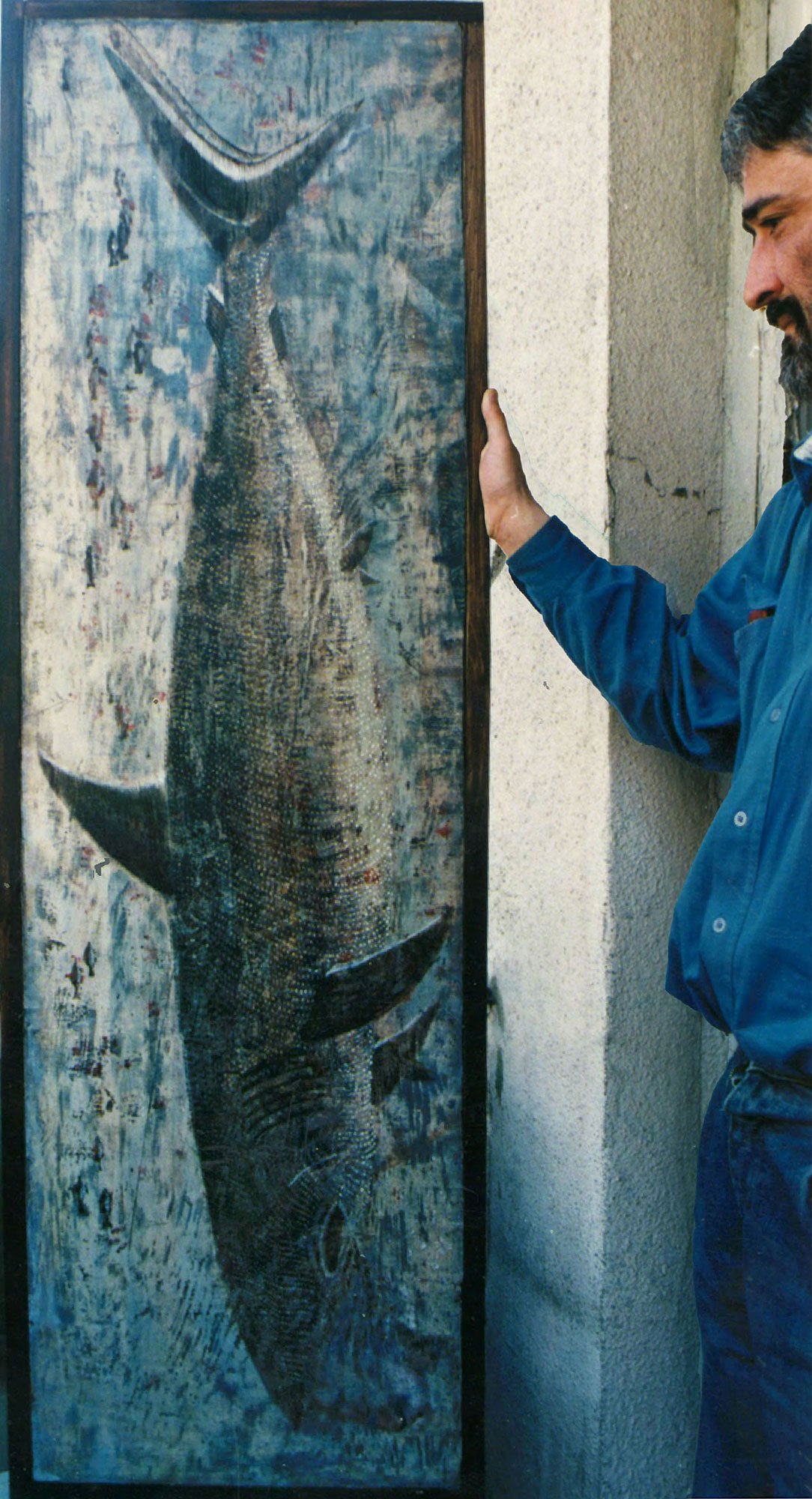
From 1975 to 1981, the artist studied at the Tbilisi State Academy of Arts, Faculty of Easel Graphics. Immediately after graduating from the academy, he began working as a painter, choosing the levkas technique and tempera as his primary means of expression. He studied and produced copies of Georgian frescoes. Synthesizing Georgian wall and icon painting techniques, he created a specific method for transforming monumental paintings into the easel format. His work began to focus on the religious model of the cosmogonic scheme of the universe.
From 1987 to 1991, Abramishvili was a member of the creative workshop at the Tbilisi Exhibition Center, known as the Artist’s House, which served as a working space for the group “The Generation of the 80s.” At the end of the 20th century, this group determined the main direction of Georgian art—a period when, in the problematic crisis environment of the post-Soviet era marked by war (the Abkhazian War of 1992–1993 and the Tbilisi Civil War of 1991–1993), economic collapse, and dehumanization, an ideal model of the universe was created that focused on a humanistic position. “The Generation of the 80s” continued to reveal in a new form the traditions of the avant-garde and modernist movements of Georgian art of the early 20th century. In 1989, Merab Abramishvili opened his studio at the Artist’s House, which burned down in 1991, along with sixteen works created there.

Starting from the 1990s, Merab Abramishvili has became an important participant in the artistic process in Georgia. His work focuses on the synthesis of Eastern and Western cultures characteristic of Georgian art and represents specific features of this event through modern structures. Therefore, his painting is interesting in terms of historical, national, and international contexts, attracting attention with its distinctive and original style and special technique, informativeness of cultural memory, transformation of eternal values, and humanistic systems of creative work.